





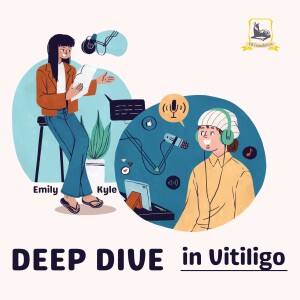
Deep Dive In Vitiligo

Explore the powerful story of vitiligo—a ‘white armor’ that challenges, empowers, and inspires resilience. Join us weekly as we delve into the science, medicine, philosophy, and personal experiences behind this intricate skin condition. Hosted by Yan Valle, CEO of the VR Foundation and author of Amazon’s bestselling book on vitiligo, this podcast breaks down cutting-edge research and celebrates stories of strength. With our engaging AI-driven anchors, we make even complex ideas both accessible and captivating. Let’s dive in together and reimagine what it means to embrace, thrive, and shine with vitiligo!

Listen on:

  • Podbean App
  • Spotify
  • Amazon Music
  • iHeartRadio
  • PlayerFM
  • Podchaser

Episodes

Monday Dec 01, 2025

Vitiligo may show up on your skin, but the drama starts lower down — in your gut, where trillions of microbes run the show. When that microscopic circus gets out of tune, your immune system can lose its mind.
Enter sucralose — that “harmless” fake sugar in your diet soda and protein shake. It tastes sweet, promises zero calories, and might just be quietly gaslighting your gut bacteria. The result? More inflammation, less balance, and a very confused immune system.
In this episode:
How sucralose messes with your microbiome
Why that matters if your immune system’s already on edge
The fine line between calming inflammation and killing defense
And why “sugar-free” doesn’t mean consequence-free
Your gut’s a garden, not a chemistry set. Sucralose won’t nuke it overnight — but it might slowly evict the good tenants and hand the keys to the troublemakers.
Full story: Sucralose, Your Gut, and Vitiligo – Should We Worry?
 

Monday Nov 24, 2025

From Easter Island soil to modern skin science — meet rapamycin, the molecule that might just change vitiligo care.
Once known mainly as an anti-rejection drug for organ transplants, rapamycin is now being tested as a topical treatment that could both calm the immune attack and help pigment return. Early studies look promising: minimal side effects, slow but steady repigmentation, and surprisingly good tolerance.
In this episode, we explore:
How rapamycin rewires the skin’s immune balance
Why it’s called both a suppressor and a rejuvenator
What Phase II trials are revealing so far
And whether this “longevity drug” might also restore color to the skin
It’s too early to call it a breakthrough — but this little molecule from a far-off island might just be the next quiet revolution in vitiligo therapy.
Full story: Topical Rapamycin: Could This Be Vitiligo’s Next Big Breakthrough?


Monday Nov 17, 2025

Vitiligo isn’t just skin deep — it’s a full-body story. Almost half of those living with it also face anxiety or depression, tied together by the same stress circuits that link the brain and the skin.
In this episode, we dive into how antidepressants affect both body and mind — and why that matters for vitiligo care.
You’ll hear:
How stress hormones can trigger or worsen pigment loss
What The Lancet revealed about antidepressant side effects
Which medications support balance without tipping the scale
Why therapy, sleep, and lifestyle still matter more than any pill
A grounded look at the skin–brain connection — and how healing the mind can help the skin follow.
Full story: Vitiligo and Mental Health: How Antidepressants May Shape the Body
 

Monday Nov 10, 2025

What happens when a diagnosis becomes a movement?
In this episode, we follow vitiligo’s unlikely journey from clinic charts to concert stages — a story painted in art, music, film, and unapologetic self-expression. From rickshaw parades in Chandigarh to AI-generated portraits in Toronto and a wax figure at Madame Tussauds New York, creativity has become the heartbeat of World Vitiligo Day.
You’ll hear:
How art and photography broke decades of silence
How AI and digital media turned awareness into art
How music, film, and pop culture gave vitiligo a voice
And why visibility is no longer just about being seen — but being felt
This isn’t just about skin. It’s about courage, culture, and the wild power of creativity.
Where science meets emotion. Where pigment becomes poetry. Where millions stand up and say — this is me.
Full story: Vitiligo — A Global Creative Uprising


Tuesday Nov 04, 2025

When we launched vitiligo.ai back in 2023, the idea was simple: make reliable information about vitiligo available to anyone, anywhere, in any language. What could possibly go wrong, right?
Fast forward two years — turns out AI can sound smart, act caring, and still be utterly clueless. It imitates empathy but doesn’t actually care. It oozes confidence but often has no idea what it’s talking about.
In this episode, Yan Valle — professor, researcher, and the slightly obsessive nerd behind vitiligo.ai — shares what really happens when you try to teach a machine to teach medicine. The wins, the fails, and the very human mess in between.
You’ll hear:
Why AI gets the facts right but the feelings wrong
How “AI therapists” can cross lines no human ever should
Why biased data quietly poisons good science
And what dermatology looks like when algorithms start calling the shots
AI is brilliant at answering questions — just not always the right ones.
This episode is a reminder that intelligence is easy to fake. Humanity isn’t.
Here's the long read

Tuesday Nov 04, 2025

This one’s long overdue — but too important to ignore.
On May 24, 2025, the World Health Organization finally looked up from its stack of pandemics and cholesterol charts and said, “Oh right — skin diseases exist.” They’re now officially a global public health priority.
Took only 2 billion people and a few decades of collective itching, burning, and patching to get there.
In this episode, we break down what this shiny new WHO resolution actually means — and what it absolutely doesn’t. Vitiligo didn’t make the guest list (unless you’re psoriasis, Buruli ulcer, or Mycetoma — congrats, I guess), but the door to real recognition just cracked open.
We’ll talk about:
Why this resolution matters — even if it’s 90% PR and 10% progress
How patient advocates quietly dragged skin health onto WHO’s radar
What it’ll take to turn this bureaucratic “maybe” into something that actually helps people
It’s not the revolution — it’s the prelude.
But hey, after years of being ignored, even a polite nod from Geneva feels like a small win.
Here’s the original post

Tuesday Nov 04, 2025

Vitiligo has always had a delivery problem. Creams can’t get past the skin’s outer “brick wall,” and systemic drugs hit the whole body.
Now, nanotechnology is changing that — turning microscopic carriers into smart delivery trucks that sneak medicine exactly where it’s needed.
In this episode:
Why most creams fail to reach pigment cells
How nano-formulations like liposomal khellin and ethosomal psoralens boost light therapy
What’s coming next — topical JAK inhibitors, antioxidant particles, even gene-editing patches
Nanotech isn’t a cure, but it’s making current treatments sharper, safer, and more precise.
The future of vitiligo therapy might just fit on the head of a pin.
For more details, read Nanotechnology for Vitiligo in 2025 – Tiny Tools, Big Hopes
 

Tuesday Nov 04, 2025

Let’s be honest — when vitiligo hits your hands, there’s no hiding it. You notice. Everyone notices. And that’s what makes it one of the toughest forms to live with — and to treat.
The good news? A new study out of Osaka University finally gives this problem some structure. For the first time, scientists mapped out four clear subtypes of hand vitiligo — from small scattered patches in kids to full-blown depigmentation in adults. Each behaves differently. Each demands a different plan.
In this episode, we dig into what that means — not just for dermatologists and researchers, but for anyone who’s ever looked down at their hands and wondered what the hell is going on.
We also connect the dots with the previous VRF study, Rethinking Vitiligo: Five Distinct Faces of a Complex Disease and talk about where science is heading next — mechanical stress, smoking, JAK inhibitors, and all the messy human stuff in between.
No hype. No miracle cures. Just real data, real patterns, and a little more clarity in a field that desperately needs it.
Available everywhere you get your podcasts.
Full details: Defining the Landscape of Hand Vitiligo
 

Tuesday Oct 14, 2025

Forget everything you thought you knew about vitiligo.
In this episode, we explore a groundbreaking new classification that shifts the focus from where vitiligo appears to how it behaves — offering doctors and patients a smarter, more predictive framework for care.
Ditch the old “segmental vs. non-segmental” divide. Meet five real-world phenotypes:
Highly Active VitiligoPatches that spread quickly, feel itchy, and often appear after an injury or impact to the skin. This type tends to grow faster and may require urgent treatment.
Mild VitiligoSmall, steady patches that don’t change much over time. These are often easier to manage and may respond well to simple treatments.
Extensive VitiligoPatches cover a larger area and can be long-lasting. It’s common to see white or gray hair in affected areas, and this type can be tougher to treat.
Koebner Type (Moderate–Severe)Patches appear in areas where the skin has been rubbed or irritated, similar to friction zones. Activity may be lower here, but the pattern follows where the skin has been touched or scratched.
Koebner Type (Mild)Small, localized patches that stay put and are often easier to treat with creams or topical therapies.
We explore each type, how they’re treated, and why this matters for personalized medicine, clinical trials, and patient outcomes.
🔗 Read the full breakdown: Rethinking Vitiligo – Five Distinct Faces of a Complex Disease

Monday Sep 29, 2025

That 2 p.m. crash isn’t just about carbs, boredom, or Netflix binges. A sweeping new study of 6,000 people shows your blood chemistry — the hormones, fats, and even last night’s cheese board — may be scripting your afternoon slump.
In this episode, we unpack the seven molecules linked to daytime sleepiness, from omega fatty acids that keep you sharp to tyramine (hello, wine and parmesan) that makes men especially groggy.
We’ll explore how stress hormones, diet, and even skin conditions like vitiligo tie into your energy levels — and why one in three adults worldwide wrestle with this “minor” problem that actually drives accidents, obesity, and poor health.
It’s a story of metabolism, not willpower. Think of it as your biochemical fingerprint for wakefulness — and a glimpse at a future where your doctor might prescribe walnuts, sushi, or morning light instead of a third espresso.
☕ Tune in for a science-meets-everyday-life deep dive that might change how you think about your post-lunch haze.
Read more:
Why You’re Sleepy After Lunch (Hint: It’s Written in Your Blood)

Dive Deeper

For deeper insights and real-time questions, check out the AI-Guide On Vitiligo.

This AI Guide offers deep insights into vitiligo research, treatments, nutrition, and mental health. Interacting with our guide is a breeze. It chats and talks in over 50 languages, catering to everyone from curious kids to brainiac professors. 

Just a gentle reminder: For personal health decisions, always consult a medical expert. 

Copyright 2024 All rights reserved.

Podcast Powered By Podbean

Version: 20241125